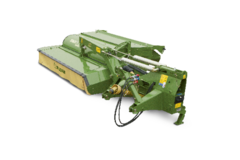
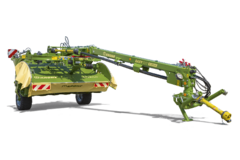
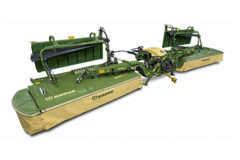
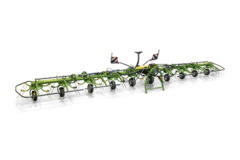
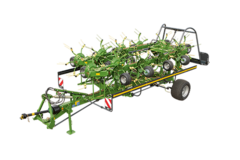
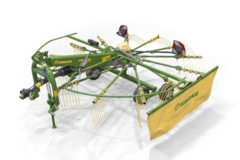
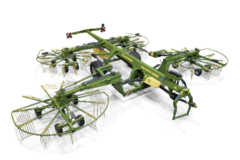

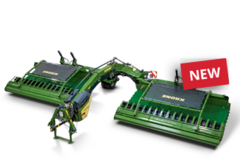





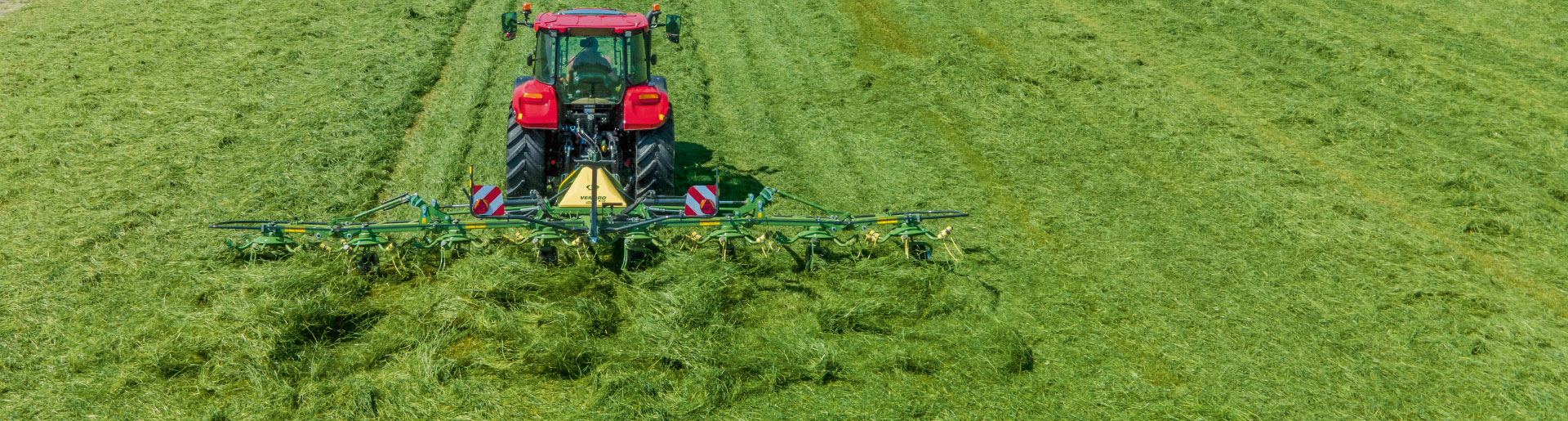


KRONE rotary tedders spread the crop evenly across the field when spreading and turning forage. The rotating rotors pick up the cut forage with their tines, mix it and spread it over a wide area. This creates a large surface area for drying and allows the crop to dry evenly. KRONE offers a range of machine concepts for different farm sizes, tractors and operating conditions – from compact three-point-mounted tedders to trailed machines for large areas and specialist equipment for steep slopes.
Uniform spreading for high-quality forage
Efficient drying depends on picking up the forage cleanly and spreading it as evenly as possible across the field. On the KRONE Vendro, the tine arms of adjacent rotors overlap extensively to ensure a uniform spreading pattern. The three-dimensionally curved OptiTurn tines support both crop pick-up and controlled release. Tine legs of different lengths also create a combing effect that mixes the different layers of forage.
Gauge wheels positioned close to the tines help the rotors follow the ground contours. This allows the tines to follow the terrain without digging unnecessarily into the soil. It protects the sward and helps prevent unwanted soil contamination of the forage.
Spreading and turning to suit the crop
The requirements for spreading and turning vary according to the moisture content and condition of the forage. The spreading angle of KRONE rotary tedders can therefore be adjusted to suit the conditions. Vendro offers four settings between 13° and 19°. A steep spreading angle allows more intensive conditioning of freshly cut crops, while a shallower angle is suitable for gently turning forage that is already drier.
Controlled spreading is also important at the field edge. A border spreading system directs the crop away from the edge and towards the centre of the field. It prevents forage from being thrown beyond the field boundary, avoiding forage losses.
Depending on the machine and equipment, the setting can be adjusted hydraulically from the tractor cab. This ensures a uniform spreading pattern even along field edges.
Rotary tedders for different working widths and operating conditions
The KRONE range includes rotary tedders for different farm sizes, tractors and field layouts. The Vendro series offers models with various working widths and mounting concepts. The three-point-mounted range extends, for example, from the Vendro 470 with a working width of 4.70 m to larger models with correspondingly higher work rates, such as the Vendro 1120 with a working width of 11.20 m – the largest three-point-mounted machine.
High-performance tedders with large working widths are available for large areas. The Vendro C 1340 has replaced the previous KWT 1300 and complements the large-area range alongside the trailed KWT 1600 and KWT 2000. The KWT models have working widths of 15.30 and 19.60 m and operate with 14 and 18 rotors respectively. Their own transport running gear enables the trailed KWT rotary tedders to combine large working widths with comparatively low power and lift capacity requirements.
KRONE also offers Vendro Highland rotary tedders to meet the particular demands of mountain regions. The Vendro 420 Highland, Vendro 620 Highland and Vendro 820 Highland have working widths of 4.20 m, 6.20 m and 8.20 m respectively and are designed specifically for demanding terrain. In particular, the low centre of gravity close to the tractor and the low machine weight of the Highland models are key factors for safe operation on slopes.
Alongside the OptiTurn rotor concept, hydraulic damping struts are among the features that help the Vendro Highland track steadily on slopes. The hydraulic border spreading system can also be used for infinitely variable uphill spreading. The Smart Climbing headstock allows different mounting positions and is designed to optimise weight distribution between the machine and tractor for work on steep slopes.
Robust technology for professional forage harvesting
In addition to work quality and forage conditioning, KRONE places great emphasis on robust, low-maintenance driveline technology. On Vendro, the OctoLink finger coupling transfers drive power from one rotor to the next. Power transmission is maintained even when the frame sections are folded. The rotor gearboxes, permanently lubricated with semi-fluid grease, are also maintenance-free. This driveline concept is also used on the Vendro Highland models.
With Vendro, KWT and Vendro Highland, KRONE offers tedders for a wide range of forage harvesting requirements. Various working widths and mounting concepts, precise ground contour following and flexible adjustment options allow the machines to be matched to the farm, tractor, crop and field conditions. Uniform spreading supports efficient drying and provides the basis for producing high-quality forage.
What is a rotary tedder?
A rotary tedder is a forage harvesting machine that picks up cut grass or other crops, loosens the material and spreads it evenly across the field. Several rotating rotors fitted with tines pick up and release the crop. Spreading the crop across a wide area creates a large drying surface, helping it dry as evenly as possible.
Rotary tedders are used both to spread freshly cut forage and to turn crops that have already started to dry.
What is the difference between a rotary tedder and a rotary rake?
A rotary tedder spreads the crop as evenly and loosely as possible across the field to promote drying. A rotary rake has the opposite purpose: it gathers the forage lying in the field into a swath so that it can then be picked up by a forage harvester, forage wagon or baler, for example.
In the harvesting process, the rotary tedder is therefore generally used before the rotary rake. After mowing, the forage is spread or turned and, once sufficiently dry, gathered into swaths.
What is the difference between spreading and turning?
Spreading distributes freshly cut crops as evenly and loosely as possible across the field. The aim is to create a large surface area for fast, uniform drying. Turning picks up and mixes forage that has already started to dry, allowing wetter layers to dry more effectively too.
The working intensity can be adjusted to suit the condition of the forage. On the KRONE Vendro, for example, the spreading angle can be set in four steps between 13° and 19°.
Why is uniform wide spreading important when tedding?
Uniform wide spreading creates drying conditions that are as consistent as possible for the entire crop. When forage is spread loosely and evenly across the working width, it can wilt more uniformly. This helps make efficient use of available harvesting windows.
On KRONE rotary tedders, the OptiTurn rotor concept, particularly the OptiTurn tines with their special three-dimensional curvature, ensures an even spreading pattern and thus uniform forage drying.
Which spreading angle is suitable for spreading and turning?
The appropriate spreading angle depends on the condition of the crop and how dry it is. Freshly cut forage needs more intensive conditioning when spreading, while drier crops should be handled more gently when turning. On KRONE Vendro rotary tedders, the spreading angle can be adjusted without tools in four steps between 13° and 19°. A steeper angle provides more intensive conditioning, while a shallower angle treats the crop more gently.
What working width should a rotary tedder have?
The appropriate working width of a rotary tedder should be matched to factors including the mower's working width, the required area output and the available tractor. As mowing can generally be carried out at higher speeds than subsequent spreading and turning, the rotary tedder should be correspondingly wider. As a guide, its working width can be around 1.5 to 2 times that of the mower. This allows similar area outputs for both operations and helps the cut forage to be worked and wilted as evenly as possible.
Matching the tedder to the mowing swaths is also important for effective spreading. Ideally, each mowing swath should be picked up by two rotors at the same time. Driving over the crop should be kept to a minimum to avoid forage contamination. The mowing swaths should therefore pass as centrally as possible between the tractor tyres.
How many rotors does a rotary tedder have?
The number of rotors depends mainly on the model, working width and rotor diameter. There is therefore no single rotor count across the KRONE range. The Vendro range, for example, includes models with four to twelve rotors. The high-capacity models also use different rotor counts: Vendro C 1340, KWT 1600 and KWT 2000 are designed for correspondingly large working widths.
As well as the rotor count, the rotor diameter and the number of tine arms per rotor play an important role in how the machine works and spreads the crop evenly across a wide area. The machine should therefore be selected according to the required working width, area output and operating conditions, rather than rotor count alone.
What is the purpose of a rotary tedder's border spreading system?
A border spreading system directs forage at the edge of the field towards the usable area. This helps prevent crops from being thrown beyond the field boundary, for example onto tracks or neighbouring land. When working on slopes, the border spreading system can also be used to direct the crop uphill.
Depending on the KRONE model, the border spreading system is operated mechanically or hydraulically. Even the mechanical version can be adjusted from the tractor: pulling a rope releases the mechanical lock so that the border spreading system can be repositioned. Hydraulic versions are operated via the tractor's hydraulics.
Why is good ground contour following important for a rotary tedder?
Good ground contour following ensures that the tines reliably pick up the crop without unnecessarily digging into the soil. This protects the sward and reduces the amount of soil and other contaminants entering the forage.
On the KRONE Vendro, the guide wheels are therefore positioned close to the tines' working area. Combined with the rotors' freedom of movement, this arrangement enables precise ground contour following and clean forage pick-up.
Which rotary tedders does KRONE offer?
With Vendro, KWT and Vendro Highland, KRONE offers rotary tedders for a variety of operating conditions. The Vendro series includes different working widths and machines with different mounting concepts. KWT denotes trailed high-capacity rotary tedders with large working widths.
The Vendro Highland models are specifically designed for the demands of mountain regions and steep slopes. The KRONE range therefore extends from compact three-point-mounted machines to the KWT 2000 with a working width of 19.60 m.
What is KRONE OptiTurn?
OptiTurn is KRONE's rotor concept for uniform, clean forage conditioning. A key feature is the three-dimensionally shaped tines. Their shape supports crop pick-up and controlled release. Tine legs of different lengths create a combing effect that mixes different layers of forage.
Together with the overlap between adjacent rotors, this achieves uniform wide spreading of the forage. The OptiTurn concept is used on both Vendro and Vendro Highland.
What makes the Vendro Highland different from other rotary tedders?
The Vendro Highland was developed specifically for the demands of mountain regions and steep slopes. In addition to the OptiTurn rotor concept, it features technical solutions designed for challenging terrain. These include hydraulic damper struts for stable tracking and a hydraulic border spreading system that can also be used for stepless adjustment of uphill spreading.
Another distinctive feature is the KRONE Smart Climbing headstock. Different mounting positions allow the centre of gravity to be changed. In the short mounting position, the system reduces the loss of load on the tractor's front axle by up to 20% compared with other mounting concepts.