
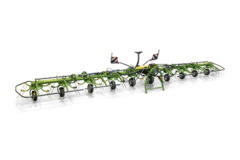
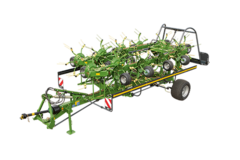




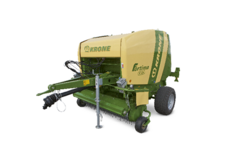
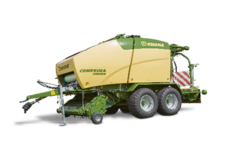
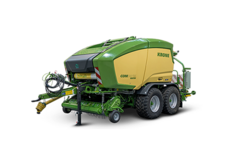
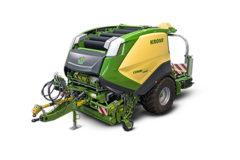
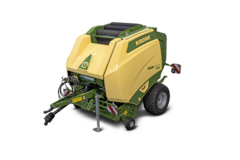
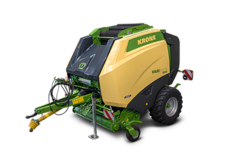

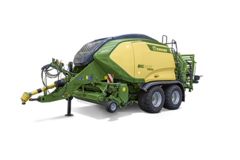
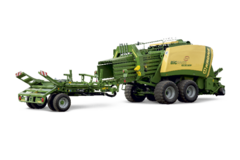


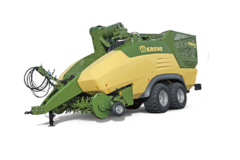
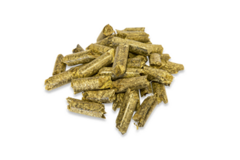
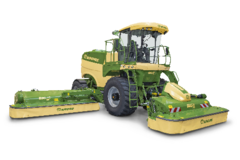
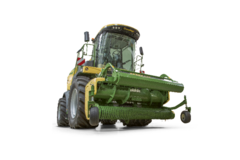
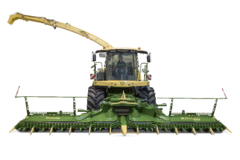










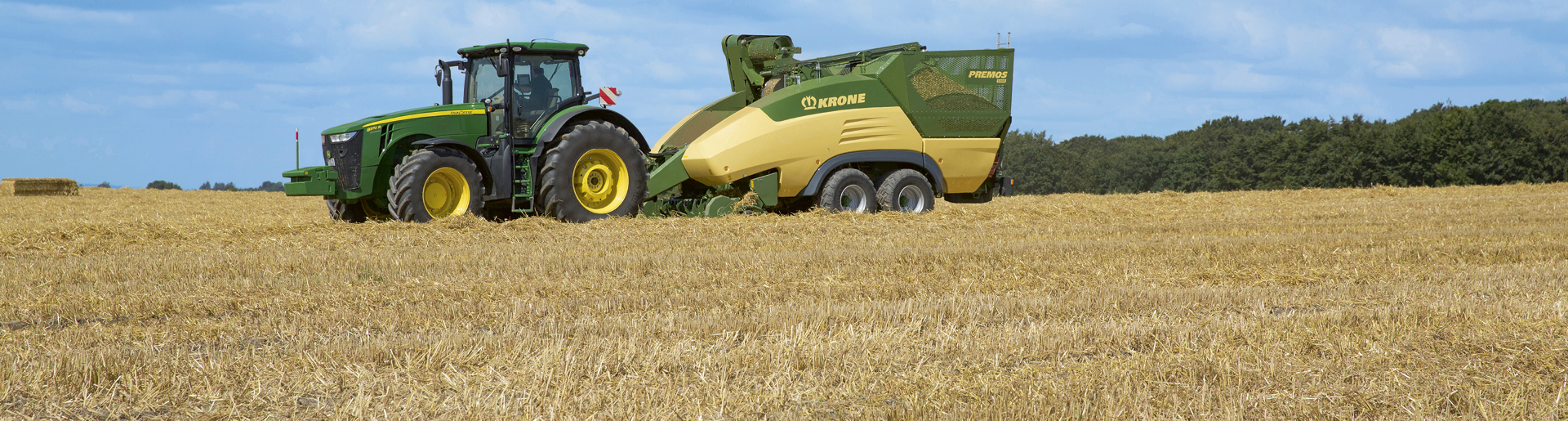


The KRONE Premos 5000 produces high-fibre pellets from straw, hay and lucerne directly on the farm. The pellet press can be used both as a mobile machine in the field and in stationary operation, processing stalk crops into compact high-fibre pellets. In mobile operation, the machine picks up the crop directly from the swath and processes it in the field. In stationary operation, pre-formed bales can be fed into the pellet press via a bale shredder. The Premos 5000 thus combines pellet production with a high degree of flexibility in terms of operating location and raw material.
How high-fibre pellets are produced
At the heart of the pellet press are two counter-rotating die rollers. The material passes between the rollers, which feature alternating rows of teeth and perforated dies. The teeth on one roller force the crop through the channels in the perforated die of the other roller. Depending on the material, the pressing process generates pressures of up to 2,000 bar and temperatures of up to 90 °C. The die openings determine the pellet diameter of 16 mm; pellet length can be adjusted between 15 and 40 mm.
From swath to finished pellet
In mobile operation, a 2.35 m wide pick-up collects straw, hay or lucerne from the swath. A feed rotor moves the material into the intake channel. A conveyor belt then transports it to the die rollers, where the high-fibre pellets are formed. A metering system can add water or oil to adjust the moisture content and binding properties of the material for the pelleting process. Depending on the crop, the Premos 5000 achieves a throughput of up to 5 tonnes per hour. Liquid additives can also be used to increase pellet strength, particularly in very dry conditions.
After pressing, the pellets undergo further processing inside the machine. Augers convey them from the rollers to the elevator and then to a rotary screen. Here, fines are screened out and returned to the die rollers. The finished pellets are conveyed into the 9 m³ pellet hopper, where they are cooled. The high-fibre pellets can then be transferred directly onto a transport vehicle via the unloading conveyor.
A pellet press for mobile and stationary operation
A distinctive feature of the Premos is its combination of mobile and stationary operation. In the field, the pellet press can pick up stalk crops directly from the swath and process them into a bulk material suitable for transport. In stationary operation, bales are fed into the machine via a feed table approximately 7.5 m long and an integrated bale shredder. The baler twine is removed automatically before shredding rollers prepare the material for the subsequent pelleting process. This allows the Premos to produce high-fibre pellets outside the harvest season as well.
High-fibre pellets for feed, bedding and other applications
The high-fibre pellets produced by the pellet press differ from conventional DIN pellets. They are made from unchopped stalk crops and have a diameter of 16 mm. Their high fibre content opens up a range of uses: for example, high-fibre pellets can be used as livestock bedding, as a source of structural fibre in feed and for energy generation. The accompanying information page on high-fibre pellets also highlights their high absorbency and low dust content as key properties of these compressed pellets.
KRONE Premos 5000: innovative technology
With the Premos 5000 pellet press, KRONE offers an innovative machine for producing high-fibre pellets directly in the field or in stationary operation. Crop intake, die rollers, screening, cooling, a hopper and conveying systems bring the entire pelleting process together in one machine. Straw, hay or lucerne is thus turned into a versatile product for farming, livestock production and energy applications, providing an additional way to use agricultural material and generate substantial added value.
What are structural pellets?
Structural pellets are pellets made from stalk crops such as straw, hay or lucerne. The KRONE Premos 5000 compresses the unchopped material under high pressure to produce structural pellets with a diameter of 16 mm. Their distinctive feature is that the stalk structure is retained within the pellets. When the pellets break down, this structure is released again, making them particularly attractive for feeding and bedding. They can be produced directly in the field from the swath or in stationary operation from previously baled material.
What is the difference between structural pellets and conventional pellets?
Structural pellets differ from conventional pellets primarily in their size and high proportion of retained plant structure. The structural pellets produced by the KRONE Premos 5000 have a diameter of 16 mm and are made from unchopped stalk crops such as straw, hay or lucerne. Thanks to the retained plant structure, they are suitable, for example, as livestock bedding, where the structure helps form a good bedding mat, or as a source of structural fibre in feed.
How does a pellet press work?
A pellet press compresses the raw material under high pressure to form pellets. In the KRONE Premos 5000, unchopped stalk material passes between two counter-rotating die rollers with alternating rows of teeth and holes. The teeth on one roller force the material through the die channels in the other roller. Depending on the crop, this generates pressures of up to 2,000 bar and temperatures of up to 90 °C. The finished structural pellets have a diameter of 16 mm and an adjustable length of 15 to 40 mm.
Can a pellet press be used directly in the field?
Yes, the KRONE Premos 5000 can produce structural pellets directly in the field. In mobile operation, a 2.35 m wide pick-up collects straw, hay or lucerne directly from the swath. The material is then conveyed to the die rollers via a feed rotor, feed channel and roller belt, where it is pressed into structural pellets. This allows the crop to be processed into transportable bulk material while still in the field.
Are straw pellets suitable for livestock bedding?
Yes, structural pellets made from straw are very well suited to livestock bedding. Their coarse structure makes them absorbent and low in dust. One kilogram of structural pellets can absorb up to four litres of water. As they absorb moisture, the pellets gradually break down and form a soft mat with good grip. Structural pellets can be used as bedding for cattle, pigs, poultry and horses, for example.
How does the KRONE Premos 5000 work in stationary operation?
In stationary operation, previously formed bales are fed to the KRONE Premos 5000 via a feed table approximately 7.5 m long. The baling twine is removed automatically, and an integrated bale breaker prepares the material for pelleting. The loosened stalk material then passes to the die rollers and is pressed into structural pellets. This means the Premos can also be used to produce pellets outside the main harvesting season.